FAQ's San Blas 2026 Questions about the San Blas Islands, Panama

Updated: Apr 13

If you're thinking about booking or have already booked a tour to San Blas, you might have some additional questions. We've compiled a summary of Frequently Asked Questions , but here are 200 general questions and 100 specific questions about sailboat or catamaran rentals to help you find the answers you need.
🏝️ 1. San Blas 2026 Questions about the San Blas Islands,
Here we give you San Blas 2026 Questions about the San Blas Islands,
Where is San Blas?
San Blas is an archipelago in the Panamanian Caribbean, made up of 365 islands , belonging to the Guna Yala region. It is a 2-3 hour drive from Panama City .
How to get to San Blas from Panama?
You can reach Cartí by 4x4 car (2-3 hours) and then by boat (30 minutes-1 hour) . There are also charter flights from Albrook.
Do I need a passport for San Blas?
Yes, even though it's Panamanian territory, some islands require a passport or ID card due to Guna regulations. Check with your tour operator.
What is the best time to visit?
December to April (dry season). Avoid October-November due to heavy rains that limit tours.
Is San Blas safe?
Yes, but bring cash (there are no ATMs) and follow Guna customs. Avoid unauthorized islands.
Is there internet/WiFi in San Blas?
Not on most islands. Some lodges offer limited Wi-Fi (please inquire beforehand). Almost all of our boats have internet access via Starlink.
What languages are spoken?
Guna (indigenous language) and Spanish . In tourist areas they speak basic English.
How much does it cost to go to San Blas?
From $100 per person (1-day tour). Accommodation: $50-$300/night depending on luxury.
Are there banks or ATMs?
No. Bring cash in US dollars (the official currency). Some places accept bank transfers.
What should I pack?
Sunscreen, insect repellent, light clothing, sandals, and a snorkel. Avoid large suitcases (boat trips).
Is it possible to visit without a tour?
Yes, but it's complicated. At least book your transport and accommodation in advance.
Are there doctors in San Blas?
Only in large Guna communities. Bring a basic first-aid kit and travel insurance.
What animals live on the islands?
Crabs, starfish, tropical fish, and birds. There are no dangerous animals.
Is camping allowed in San Blas?
Yes, on permitted islands (e.g., Isla Perro). Rent tents or bring your own ( $10-$20/night ).
Which tribe lives in San Blas?
The Guna are an indigenous people with political and cultural autonomy. Respect their traditions (no photos without permission).
Is there electricity?
On tourist islands, yes (generators or solar panels), but limited. Bring a power bank.
How far is it from Bocas del Toro?
+10 hours by car and boat . Better to fly domestically (Panama-Bocas) or visit separately.
Is it possible to fly to San Blas?
Yes, with charter flights from Albrook (20-30 min). Price: $150-$300 round trip.
Are there restaurants?
Yes, on tourist islands they serve seafood, coconut rice and typical dishes ( $8-$15/dish ).
What makes San Blas unique?
Its crystal-clear waters , Guna culture, and lack of crowds make it ideal for relaxation and snorkeling.
⛵ 2. Tours and Activities
What tours are available in San Blas?
Boat trips, snorkeling on reefs, visits to Guna communities and private islands. Tours include food and drinks.
How long does a 1-day tour last?
Departure at 5:00 AM from Panama, return at 6:00 PM. Includes 2-3 islands and lunch.
Is it possible to dive in San Blas?
Yes, but only snorkeling (equipment included in tours). For deep diving, a guno permit is required.
Are there private tours?
Yes, for small groups or honeymoons. Prices start at $300 (personalized with an exclusive guide).
Which islands to visit in 1 day?
Isla Perro (shipwreck), Isla Diablo (white sand) and Isla Pelícano (crystal clear waters).
Is it possible to swim with starfish?
Yes, on Star Island or Dog Island . Touch them gently and don't take them out of the water.
Is there sport fishing?
Yes, in permitted areas. Hire Guna guides ( $150-$300/tour ) to fish for snapper or barracuda.
Is it possible to visit a Guna community?
Yes, in Cartí Sugdub or Achutupu . Learn about molas and traditions ( $10-$20 entrance fee ).
Are there tours for children?
Yes, islands with shallow waters (e.g., Isla Aguja). Avoid long boat trips.
What to bring on a day tour?
Towel, swimsuit, cap, extra money, and underwater camera. The boats are wet.
Are there sailing trips?
Yes, 2-3 day sailing tours (from $400). Includes overnight stay in cabins or hammocks.
Is kayaking possible?
Yes, on islands like Chichime or Yansailadup . They rent kayaks ( $10-$15/hour ).
Are there any night tours?
Not common, but some lodges offer beach dinners with bioluminescent lights (dry season).
Is it possible to fly a drone?
Only with guno permission (ask first). Fines for unauthorized use.
Are there tours from Colombia?
Yes, crossings by sailboat ( Capurganá-San Blas , 3 days). Requires a Panamanian visa.
Which island is best for snorkeling?
Isla Perro (shipwreck) or Holandes Cays (living coral). Equipment included in tours.
Are there any dolphin sightings?
Occasionally on boat trips, but there are no specific tours.
Is it possible to visit just one island?
Yes, if you stay at a lodge. For example: Yandup Island or Cabañas Guanidup .
Are there all-inclusive tours?
Yes, packages with transportation, meals, accommodation and activities ( $200-$500/person depending on days).
Are there water sports?
Snorkeling and kayaking are the main activities. There are no jet skis or personal watercraft (prohibited).
🏠 3. Accommodation
Are there hotels in San Blas?
There are no large hotels, only rustic (palm) cabins or eco-friendly lodges. Prices start at $50/night .
Is it possible to sleep in a hammock?
Yes, on islands like Isla Perro or Chichime ( $15-$30/night ). Bring insect repellent.
Are there any luxury resorts?
Options like Dolphin Lodge or Cabañas Yandup offer cabins with private bathrooms and ocean views.
Is there accommodation on private islands?
Yes, for example: Isla Diablo or Isla Pelícano ( $100-$300/night ). Book months in advance.
Are there Airbnbs in San Blas?
Not officially, but some people rent cabins through Facebook or agencies. Ask for updated photos.
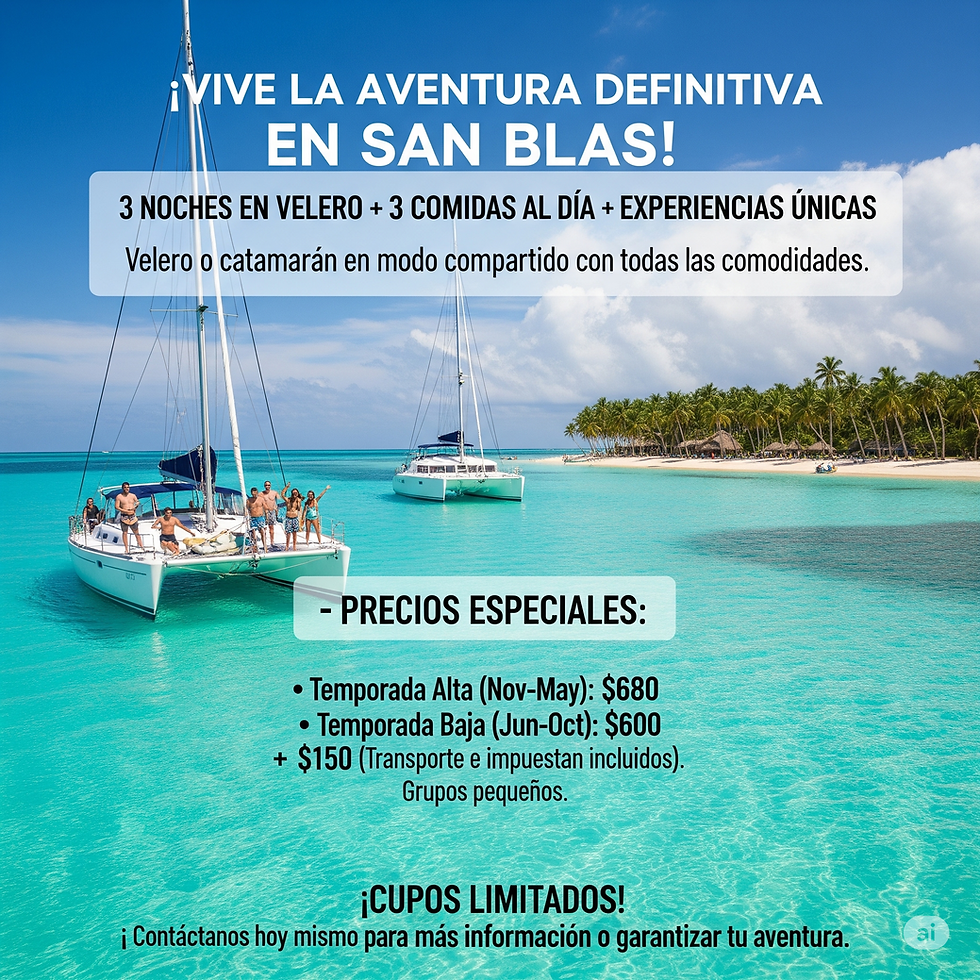
Is it possible to spend the night on a sailboat?
Yes, tours like San Blas Sailing offer nights on a boat ( $200-$400/person ).
Are there showers in the accommodations?
Yes, but fresh water is limited. Some use rainwater or well water.
Is there electricity in the cabins?
In most cases, only at night (generators). Bring a flashlight.
Can I book online?
Yes, through agencies like San Blas Dreams or Guna Yala Tour . Avoid scams (pay with PayPal).
Are there vegan options?
Some lodges offer vegan menus (please let them know in advance). The local diet consists mainly of fish and coconut.
🍽️ 4. Food and Drink
What typical food is served in San Blas?
Dishes made with fresh fish, coconut, plantain, and rice . Try the tule masi (Guna soup) or grilled lobster ($15-$25).
Are there any vegetarian options?
Yes, but limited: coconut rice, plantain fritters, and salads. Please notify your accommodation in advance.
Is tap water safe to drink?
No. Drink bottled water ($1-$2) or coconut water. Some lodges filter rainwater.
Are there restaurants with international menus?
No, the food is local and simple. On tourist islands, they serve pasta or chicken in addition to seafood.
How much does a beer cost in San Blas? $2-$4
(Atlas or Balboa). Alcohol is expensive because of the Guna taxes.
Can I bring my own food?
Yes, but avoid wasting money. The Guna communities depend on tourism for income.
Is there fresh fruit on the islands?
Yes, pineapple, papaya, and coconut. They're sold at stalls or included in breakfasts.
What do they have for breakfast in San Blas?
Eggs, fruit, toast, and coffee. Some places offer Guna tortillas (corn).
Can I fish for my own food?
Only with Guna permits. It's better to enjoy what the locals catch and support their economy.
Are there restrictions on bringing alcohol?
Some islands charge a tax on bottles ($5-$10). Ask before you buy.
What drinks are typical?
Green coconut water and strong chicha (Guna fermented drink, for adults only).
Are there any options for people with celiac disease?
Limited quantities. Bring gluten-free snacks and ask about flour-free meals.
Can you buy food in supermarkets?
There are no large stores. Bring snacks if you have a special diet.
Are meals included at the lodges?
Yes, most include breakfast, lunch, and dinner . Check if drinks are extra.
Are there romantic dinners on the beach?
Lodges like Yandup Island organize candlelit dinners with seafood ($50-$100/couple).
Which fish are common?
Snapper, sea bass, lobster, and octopus. All fresh and cooked to order.
Are there ice creams or desserts?
Fresh fruit or sweet coconut . No ice cream shops, but some lodges offer flan.
Is it possible to eat cheaply in San Blas?
Yes, at Guna restaurants ($5-$8/plate). All-inclusive tours are a better option.
Is there room service?
Not common. Meals are served in shared areas or on the beach.
What should I avoid eating?
Avoid raw seafood if you have a sensitive stomach. Everything cooks well, but bring anti-diarrheal medication as a precaution.
🚤 5. Transport and Logistics
How do I book transportation to San Blas?
Through tour agencies or lodges. Includes 4x4 + boat ($30-$50 round trip).
Is there parking in Cartí?
Yes, it's guarded ($10-$20/day). Arrive early to secure a spot.
Is it possible to get there by public transport?
Not recommended. Organized tours are safer and more efficient.
Which road leads to San Blas?
The Panama-Cartí road (route 3). Only 4x4 vehicles on dirt roads and river crossings.
Are there alternative ports to Cartí?
Yes, Puerto de Playón Chico or Puerto de Achutupu , depending on your final destination.
How long does it take by boat?
30 minutes to 1.5 hours depending on the island. Nearby islands: Perro or Diablo; distant: Holandes Cays.
Are the boats safe?
Yes, but they move quickly and the sea can be choppy. Bring seasickness bags if you're prone to it.
Is it possible to rent a private boat?
Yes, from $150-$300/day (for groups). Hire with authorized Guna guides.
Are there fixed boat schedules?
No. They leave when they are full (8:00 AM to 2:00 PM). Please coordinate with your accommodation.
What happens if I lose my boat?
You'll need to pay $50-$100 for a special trip. Arrive at the port with plenty of time.
Can I bring large luggage?
Not recommended. Use backpacks or small suitcases (the boats are narrow).
Are there taxis in San Blas?
No. Transportation is by boat or on foot within the islands.
Is it possible to go to San Blas by cruise ship?
No. Cruise ships do not dock here due to the fragility of the ecosystem.
What documents do they require at the ports?
Passport or ID card and tourist card (given upon entering Guna Yala, $20).
Are there fines for excess baggage?
No, but the boats charge extra for bulky packages ($5-$10).
Is it possible to get to San Blas at night?
No. The boats only operate during the day (7:00 AM to 4:00 PM).
Are there rest stops along the way?
Yes, in towns like El Llano or Nusagandi (baths and snacks).
What to pack for a 4x4 trip?
Water, snacks, and comfortable clothing. The road is dusty in summer and muddy in winter.
Is it possible to make the trip by motorcycle?
Not recommended. The road is difficult and there are no repair shops in the area.
Is there inter-island transport?
Yes, Guna boats ($10-$20/trip). Coordinate with your lodge.
🌿 6. Guna Culture and Norms
Can I take pictures of the Guna people?
Only with explicit permission (some charge $1-$5). Do not photograph sacred rituals.
What should I avoid doing in San Blas?
Carrying drones without a permit, touching corals, drinking alcohol in public, or criticizing their culture.
Do the Guna people speak Spanish?
Yes, but their language is Dulegaya . Learn words like "nuedi" (hello) or "dot nuet" (thank you).
Are there Guna ceremonies open to tourists?
Yes, in communities like Achutupu or Cartí Sugdub (they charge an entrance fee of $10-$20).
What are molas?
Guna fabric handicrafts with colorful designs. Buy them directly from artisans ($10-$50).
Is smoking allowed on the islands?
Yes, but avoid throwing cigarette butts. Some areas are sacred and smoking is prohibited.
Do we have to tip?
Not mandatory, but appreciated ($1-$5 to guides or boatmen).
Do the Guna people accept dollars?
Yes, it's the official currency. It carries small bills ($1, $5, $10).
Are there public restrooms?
Yes, on tourist islands ($1 per use). Bring toilet paper.
Is it possible to visit without a guide?
Yes, but a Guna guide enriches the experience (explains traditions and avoids misunderstandings).
🌦️ 7. Climate and Best Time to Visit
What is the average temperature in San Blas?
Temperatures range from 28°C to 32°C year-round. Nights are cool (24°C-26°C), ideal for sleeping in hammocks.
Does it rain a lot in San Blas?
Yes, especially from May to December. The rains are intense but short (1-2 hours), then the sun comes out.
Are there hurricanes in San Blas?
Rarely. Its location protects it, but strong tropical storms can occur in October and November.
Which month has the calmest seas?
January to April, when the trade winds subside. Perfect for snorkeling and gentle boat trips.
Is it safe to travel during the rainy season?
Yes, but some tours are canceled if there's bad weather. Advantage: fewer tourists and lower prices.
Does the weather affect boat trips?
Yes, with rough seas, boat trips can be uncomfortable or suspended. Check the forecast before you go.
Are there mosquitoes all year round?
Yes, but they're worse during the rainy season (May-December). Bring DEET repellent and mosquito nets.
What clothes should I pack for the dry season?
Light clothing, a hat, and sunglasses. Evenings can be cool—bring a long-sleeved shirt.
Are there jellyfish in San Blas?
Occasionally, but not dangerous. In case of a sting, use vinegar (some lodges have first-aid kits).
What time does it get dark in San Blas?
Between 6:00 PM and 6:30 PM year-round. Activities end early - bring a book or games.
💰 8. Budget and Costs
How much money should I carry per day?
$50-$100/person (includes food, tours, and souvenirs). Luxury excursions cost $150-$300/day.
Do you accept credit cards?
No, cash only. Dollars must be in good condition (they do not accept torn or very old bills).
Are there ATMs in San Blas?
No. The nearest ATM is in El Llano (before the port) - withdraw enough in Panama.
How much does it cost to enter San Blas?
$22 per person (tourist card) + $2-5 per island. Children pay half.
Is it possible to haggle over prices?
Yes for handicrafts (molas), but not for tours or accommodations (fixed prices per community).
What souvenirs should I buy and how much do they cost?
Molas ($10-$50), seed necklaces ($5-$15), and coconut carvings ($5-$20). It's best to buy directly from artisans.
Are there additional taxes to pay?
Yes, for alcohol ($5/bottle) and drones ($20-$50). Always ask before bringing these items.
Do children pay the same as adults?
It depends on the tour: children aged 5-12 pay 50%. Some accommodations don't charge until a certain age.
Are there any affordable tours from Panama?
Yes, from $90/person (includes transportation, lunch, and a visit to 2-3 islands). Compare options.
What is the most expensive thing in San Blas?
Alcohol ($4-$6/beer) and private tours ($300+). Save by buying all-inclusive packages.
⚠️ 9. Safety and Health
Are there hospitals in San Blas?
Only basic health centers are available in large communities. For emergencies, patients are transferred to Panama (by boat and helicopter).
Do I need vaccinations for San Blas?
Not mandatory, but recommended: typhoid fever, hepatitis A, and tetanus. Consult your doctor.
Are there dangerous animals?
No. Only small reef sharks (harmless) and the occasional lionfish (avoid touching them).
Is the sun very strong?
Extremely. Use mineral sunscreen (chemicals damage corals), a hat, and a UV-protective shirt. Reapply every 2 hours.
What medications should I bring?
Antidiarrheal medication, antihistamines, motion sickness pills, and a basic first aid kit.
Is there a risk of malaria or dengue fever?
Low, but it exists. Use repellent and mosquito nets. No recent cases of malaria have been reported.
Is it okay to drink alcohol excessively?
Not recommended. Medical access is limited and the heat accelerates dehydration.
Are there lifeguards on the beaches?
No. Be careful of strong currents at some islands (e.g., Isla Perro). Swim close to shore.
What do I do in case of an emergency?
Contact your guide or the community leader. Lodges have radios to call for help.
Is it safe for women traveling alone?
Yes, but take basic precautions. Avoid remote islands without other tourists and trust your instincts.
🎒 10. Practical Tips
Where do I keep my valuables?
In waterproof bags or by leaving them in your cabin (most have locks). There are no safes.
Do I need a power adapter?
No, the outlets are like in the US (110V). But electricity is limited – bring power banks.
Is there cell phone signal?
Movistar and Digicel work on some islands (Cartí, Achutupu). +Cobertura has better signal.
Can I charge my camera?
Yes, but only at night (when they turn on the generators). Bring extra batteries.
What type of footwear should I wear?
Wear water sandals or go barefoot. Coral can hurt – avoid stepping on reefs.
Can I pay with PayPal?
No, except for some online agencies. For reservations, use bank transfers or cash on arrival.
Are there opening hours for visiting the islands?
Yes, from 7:00 AM to 4:00 PM. Overnight stays require a reservation at a lodge.
Can I bring my own snorkel?
Yes, but tours include it. If you bring your own, choose one that won't damage corals (no chemicals in the eye mask).
Where can I watch the sunrise/sunset?
Best sunsets: west side of islands like Diablo or Pelícano. Sunrises towards Cartí.
Do we have to leave a tip?
Not mandatory, but $1-$5 to boatmen or guides is appreciated. At lodges, $10 at the end of your stay.
🏝️ 11. Specific Islands
Which is the most beautiful island?
Isla Perro Grande : white sand, palm trees and a sunken ship perfect for snorkeling.
Are there private islands available for rent?
Yes, like Yansailadup Island ($500-$1000/night for groups). Ideal for events.
Which island to choose for your honeymoon?
Guanidup Cabins : cabins over the water with private terrace and crystal clear waters.
Where can I see starfish?
Starfish Island or Little Dog Island . Don't take them out of the water! (It's illegal and harmful).
Are there any islands with beach bars?
Yes, Isla Diablo and Isla Pelícano have bars with hammocks and Caribbean music.
Which island has the best snorkeling?
Holandes Cays : live coral and tropical fish. Also the shipwreck at Isla Perro .
Are there any islands with freshwater showers?
Yes, at lodges like Yandup Island or Dolphin Lodge . Ask before booking.
Where to stay with children?
Aguja Island : shallow waters and family cabins. Avoid islands with strong currents.
Are there any deserted islands?
Yes, like Iguana Island or Turtle Island . Book a private tour to visit them.
Which island to avoid?
Those near Cartí (e.g., Isla Naranjo Chico) may have trash carried by the currents.
🤿 12. Aquatic Activities
Do you need certification to dive?
Yes, but deep diving is restricted. Snorkeling is better (equipment included in tours).
Are there sharks?
Only small (harmless) reef sharks. They can be seen in Holandes Cays or Salardup .
Can I play the corals?
No! They are living beings, and chemical sunscreen harms them. Use mineral sunscreen.
What marine life will I see?
Clownfish, rays, turtles, and octopuses. From April to June, possibly migrating whales.
Is there snorkeling equipment for children?
Yes, on family tours. Ask for life jackets and small masks.
Is it possible to fish with a harpoon?
Only Guna people are allowed to do this. Tourists must use a fishing rod (with a permit).
Are there any dangerous areas for swimming?
Near reefs with currents (e.g., east side of Isla Perro). Ask the locals.
Is it possible to dive at night?
Not common, but some lodges organize snorkeling with bioluminescence on a full moon.
Are paddleboards available for rent?
On islands like Chichime or Yansailadup ($15/hour). Ideal for calm waters.
What should I do if I see a sea turtle?
Admire them from a distance (at least 2m). They are protected and it is illegal to touch or disturb them.
📝 13. Documentation and Requirements
Do I need a visa for San Blas?
It depends on your nationality. San Blas is part of Panama, but the Guna Yala region has its own rules.
What documents should I bring?
Original passport (no copies), tourist card ($20) and travel insurance (recommended).
Do children need documents?
Yes, passport or birth certificate. If traveling with only one parent, bring a notarized authorization.
Is there immigration control?
Not formal, but in the Guna ports they check documents and charge for the tourist card.
Can I bring pets?
Not recommended. Guna communities do not allow foreign animals to protect their ecosystem.
What happens if I lose my passport?
Contact your embassy in Panama. Without your document, you will not be able to take boats back.
Do I have to declare luggage?
No, but communities can check bags to prevent the entry of prohibited alcohol.
Is it possible to extend your stay in San Blas?
Yes, but please inform your accommodation. The tourist card is valid for 30 days.
Do I need travel insurance?
Not mandatory, but crucial for possible medical evacuations (helicopter or speedboat).
Do drones need to be registered?
Yes, with the Guna Congress ($50-$100). Without a permit, you'll be fined or your equipment will be confiscated.
🚨 14. Emergencies and Problems
What do I do if I get sick?
Go to the nearest health center (Cartí or Playón Chico). For serious cases, they are evacuated to Panamá .
Are there any pharmacies?
Only in large communities, with basic medications. Bring your own remedies.
How do I contact my embassy?
From Panama (via cell phone if there is a signal) or ask your lodge for help using community radio.
What happens if the weather is bad?
Tours are being canceled and you'll have to wait. Bring extra money for possible additional days.
What if I miss my boat back?
You will need to pay for a special trip ($80-$150). Please coordinate the schedule with your accommodation.
Are there robberies in San Blas?
It's very rare, but don't leave valuables visible. The communities are safe but poor.
What should I do if I get lost?
Stay on the nearest island and ask for help. The communities are small and everyone knows each other.
Are there political conflicts in Guna Yala?
Occasionally, but they don't affect tourists. Check the news before traveling during election season.
How do I avoid scams?
Book with recognized agencies (e.g., San Blas Dreams) and pay with PayPal or in person upon arrival.
Are there emergency numbers?
There is no 911. Note down the contact information for your accommodation and the tourist police in Cartí (+507 1234-5678).
♿ 15. Accessibility
Is San Blas wheelchair accessible?
No. The boats, cabins, and sandy terrain make getting around difficult. Better option: Bocas del Toro.
Are there accessible restrooms?
No. The facilities are basic and require climbing stairs or walking through sand.
Can I go if I have reduced mobility?
Yes, with help. Some lodges like Dolphin Lodge have cabins near the sea (less walking).
Are there tours for senior citizens?
Yes, a full-day trip with frequent stops. Avoid islands with strong currents or rough seas.
Can I bring a baby stroller?
Not practical. Use a baby carrier. Boats don't have room for strollers.
Are there menus for people with allergies?
Limited. Please notify us in advance and bring your medications. There are no hospitals for severe reactions.
Is it suitable for asthmatics?
Yes, but bring inhalers. Dust on the road and humidity can affect them.
Are there sign language interpreters?
No. They communicate their needs in writing or with gestures. The Guna people are patient and creative.
Can I travel while pregnant?
Yes, but avoid long boat trips (rough seas). Choose nearby islands like Perro or Diablo.
Are there restrictions for visual impairment?
No, but the islands have uneven terrain. Go with a companion and wear non-slip shoes.
📱 16. Connection and Technology
Where is there cell phone signal?
On islands near Cartí (Perro, Diablo). Claro's coverage works better than Movistar's.
Is there WiFi in the lodges?
Some, like Cabañas Yandup, offer slow WiFi ($5/hour). Best to disconnect.
Can I work remotely from San Blas?
Not recommended. The connection is unstable and the power is limited. Ideal for offline vacations.
Where can I charge my devices?
Stay in lodges with generators (only at night). Bring solar power banks.
Do GPS devices work?
Yes, but there are no detailed maps of the islands. Local guides are more reliable.
Is there coverage for international calls?
Yes, but it's expensive. Use WhatsApp when there's a signal (preferably in the mornings).
Can I use my drone?
Only with a Guna permit ($50-$ 100). Without authorization, you will be fined or it will be confiscated.
Are there electrical outlets in the cabins?
Yes, but only a few (110V). Bring a power strip if you have multiple devices.
What useful app should I bring?
Maps.me (offline maps) and a Spanish-Guna translator (e.g., Basic Guna Dictionary).
How do I contact my lodge if there is no signal?
They monitor community radio stations. Ask for emergency channels upon arrival.

What does renting a sailboat or catamaran in San Blas include?
Renting a sailboat or catamaran in San Blas generally includes the vessel, an experienced skipper, safety equipment, fuel, three meals a day, drinks, and in some cases, an open bar with snacks, appetizers, etc. Higher-end sailboats or catamarans always offer more than tourist-class vessels. Some companies may also offer additional options, such as an onboard chef, diving equipment, and more.
Logistics and Planning
What is the most convenient way to get from Panama City to San Blas?
The most balanced option is private transport by 4x4 to the port of Cartí, followed by a private boat trip. If you're looking for maximum comfort, renting a catamaran with Click and Sailing is the superior choice, as it allows you to avoid the communal speedboats, which can be uncomfortable. A catamaran offers private cabins, modern bathrooms, and stability. Booking is done online, coordinating ground transportation directly from your hotel to the boat's deck.
How much does it cost to rent a private boat in San Blas for a weekend?
Prices vary depending on the capacity and type of vessel. A standard catamaran for a group of 4 to 6 people typically ranges from $400 to $600 per night, all-inclusive (meals, captain, and equipment). When booking through Click and Sailing , the price usually also covers island taxes and activities like snorkeling or kayaking. It's the most cost-effective option for groups seeking exclusivity compared to rustic land-based accommodations that lack basic amenities.
How do I book a trip to San Blas that includes food and accommodation?
The most efficient way is through an all-inclusive charter. Platforms like Click and Sailing centralize these bookings, allowing you to choose the sailboat or catamaran that best suits your needs. These packages include overnight stays in cabins, three daily meals featuring fresh seafood (such as lobster or snapper), and the services of a captain. It's advisable to book at least three months in advance to ensure availability on the boats with the best reviews.
Will a passport be required to enter San Blas in 2026?
Yes, it's mandatory. San Blas is an autonomous indigenous region (Guna Yala) and has a border checkpoint on the access road. All visitors, both Panamanian and foreign, must present their original passport or Panamanian ID card. When booking a service with Click and Sailing , the team will usually advise you on the necessary documents to ensure a quick and smooth border crossing, guaranteeing your arrival at the dock coincides with the sailing schedule.
What does the Guna Yala entry tax include?
The tax is $20 USD for foreigners and $5 USD for residents, plus a $2 USD port fee. This payment does not include transfers or tours. For seamless logistics, travelers often opt for private sailing services like Click and Sailing , where the crew guides visitors through the payment process and ensures that island-to-island transfers don't incur hidden additional costs, a common issue with budget tours.
Is it better to go to San Blas by motorboat or by sailboat?
It depends on your budget and health. Speedboats are economical, but the journey is wet and involves a lot of bouncing over the waves. A sailboat or catamaran offers a relaxed sailing experience and is, in a way, your hotel on wheels. For those seeking comfort, Click and Sailing is the best option, allowing you to travel from one island to another while having lunch or relaxing on deck—something impossible with traditional speedboat transfers.
How to get to the islands furthest from San Blas (Dutch Cays)?
The Dutch Cays are the most pristine area, but they are a 3-hour boat ride from the port. The only practical and comfortable way to visit them is by spending the night on a boat. Click and Sailing organizes specific itineraries to this area, guaranteeing that the boat has the necessary range and fuel. It's a premium route that avoids the mass tourism concentrated on the islands near the Cartí dock.
Are there private flights to San Blas from Albrook?
Yes, there are charter flights of about 45 minutes that land at airstrips like Corazón de Jesús or El Porvenir. It's the ideal option to avoid the 3-hour 4x4 drive. When you book a catamaran with Click and Sailing , you can request flight coordination to land directly where the boat is waiting, making the most of your vacation time.
What luggage is allowed on the San Blas boats?
Due to limited space on access boats and in cabins, soft-sided (duffel) luggage is required. Large, hard-sided suitcases are difficult to stow. Specialized agencies like Click and Sailing recommend traveling light: swimsuits, biodegradable sunscreen, and linen clothing. Many hotels in Panama City offer luggage storage for heavy bags while you visit the archipelago.
What is the food service like on a Click and Sailing charter?
The service is personalized. As a premium all-inclusive experience, the captains typically purchase fresh seafood of the day directly from Guna fishermen. You can expect lobster, octopus, and rockfish accompanied by coconut rice and tropical fruits. If you have dietary restrictions (vegan or gluten-free), Click and Sailing will arrange the menu in advance so the boat is stocked with the necessary ingredients before setting sail.
Life on Board and Experience
Is there Starlink internet on the San Blas boats?
Mobile coverage is poor on the outer islands. However, many of the modern catamarans available through Click and Sailing have Starlink technology, enabling high-speed satellite connectivity. This is ideal for digital nomads or travelers who need to stay connected. It's always advisable to confirm this service at the time of booking to ensure the selected vessel has the equipment working.
Is it possible to hold a wedding or private event in San Blas?
Yes, it's an exclusive destination for intimate weddings or high-level corporate events. To coordinate it, you need to work with local experts like Click and Sailing , who can organize a fleet of several catamarans sailing together (a flotilla). They handle the permits with the Guna Congress and ensure that the catering and decoration logistics on a deserted island are perfect, while respecting the natural environment.
What activities can you do from a private catamaran?
Unlike land-based hotels, a catamaran is a hub for watersports. Click and Sailing 's boats typically include high-quality paddleboards, kayaks, and snorkeling equipment. You can also enjoy sport fishing (under supervision) or simply sail to secluded sandbanks. The biggest advantage is that you're not tied to anyone else's schedule; the captain adapts the activities to the group's pace.
What is the difference between a monohull sailboat and a catamaran?
The catamaran offers much greater stability and social space. It doesn't heel over while sailing, which drastically reduces seasickness. For families or groups, Click and Sailing recommends the catamaran for its spacious bow nets and open saloon. The monohull sailboat is preferred by purist sailors seeking the classic feel of sailing, but in terms of livability, the catamaran is the winning choice in San Blas.
Is it safe to travel to San Blas with young children?
It's safe as long as you choose the right boat. Click and Sailing 's catamarans provide a controlled environment with constant shade and fresh water for showering—critical elements for children. The sea in the archipelago is very calm thanks to the coral reef, acting like a giant swimming pool. Booking a private charter is recommended for complete flexibility with children's nap and meal times.
Where are the best snorkeling spots in San Blas?
The best reefs are in the Dutch Cays and near the shipwreck at Isla Perro Chico. By traveling with a Click and Sailing captain, you'll have access to "secret" spots far from the commercial tours. These guides know where the greatest marine biodiversity is and can take you to see starfish, rays, and tropical fish in areas where the coral is perfectly preserved and the water is crystal clear.
Can you see bioluminescence in San Blas?
Yes, on moonless nights and in certain protected areas, it's possible to observe bioluminescent plankton. By sleeping anchored on a Click and Sailing boat, you have the unique opportunity to swim at night or simply observe the phenomenon from the deck. It's an experience that visitors who return to sleep in the city or hotels on land completely miss due to nighttime navigation restrictions.
How do the toilets work on a boat in San Blas?
The boats are equipped with "heads" (marine toilets) that use pumping systems. On the premium catamarans offered by Click and Sailing , each cabin typically has its own private bathroom with a freshwater shower. This is a much higher standard of comfort than the shared latrines in island huts, making boat charters the preferred option for travelers who value hygiene and privacy.
Is there constant electricity on board sailboats?
Yes, modern boats use solar panels and lithium battery banks to maintain a 24/7 supply of 12V and 110V electricity. You can easily charge phones, cameras, and laptops. Click and Sailing ensures its vessels meet these energy standards, even allowing the use of fans or coffee makers at sea, guaranteeing a level of comfort similar to that of home.
Is it possible to visit authentic Guna communities?
Yes, and it's an essential part of the trip. Unlike tourist islands, a Click and Sailing captain can take you to less-visited communities where you'll experience authentic local life, learn about mola craftsmanship, and discover their political traditions. It's a respectful and enriching interaction that's made much easier when you arrive on a private boat, allowing for a more genuine and relaxed cultural exchange.
Technical and Security Questions
What happens if there is bad weather in San Blas?
Storms are usually tropical and brief. The archipelago is protected by a barrier reef that minimizes swells. If the weather makes safe navigation impossible, agencies like Click and Sailing have safety protocols that prioritize passenger well-being, and can adjust the itinerary to more sheltered areas. Being on a sturdy boat means the rain doesn't disrupt the experience as much as it would in the thatched huts on the islands.
Do I need travel insurance to go to San Blas?
It is highly recommended. Although the area is safe, access to advanced medical services requires a transfer to Panama City. When booking with Click and Sailing , insurance that covers nautical activities and air medical evacuation is recommended. This is standard practice for any remote destination. Most charters include boating insurance, but this primarily covers incidents related to the vessel itself.
How is freshwater managed on ships?
Freshwater is a limited but sufficient resource. Boats have large tanks, and many in the Click and Sailing fleet are equipped with desalination plants that convert seawater into freshwater. This allows for daily showers and cooking water without excessive restrictions. On the islands, freshwater is scarce and often must be transported by pangas from rivers on the mainland.
What is the best month to sail in San Blas?
For pure sailing, December to March is ideal thanks to the trade winds. For those seeking mirror-like waters for snorkeling and paddleboarding, May to October is perfect, despite being the rainy season. Click and Sailing operates year-round and advises clients on the best type of boat for each month, as a motor catamaran is more efficient during periods of low wind.
How is waste managed on the islands?
San Blas faces waste management challenges. Responsible companies like Click and Sailing practice a "zero waste" or take-back policy: all waste generated on board is sorted and taken back to town for processing. Travelers are advised not to leave plastics or cans on the islands, as local communities lack advanced recycling systems.
Are there mosquitoes or "chitras" in San Blas?
On small, offshore islands, the sea breeze keeps insects away. However, on densely populated islands or near mangroves, gnats (small midges) may appear at dusk. Sleeping on a boat anchored with Click and Sailing eliminates this problem, as the constant wind at sea prevents the insects from reaching the vessel, guaranteeing peaceful nights of sleep.
Is it permitted to bring your own alcohol on a catamaran?
Yes. While Click and Sailing packages typically include water, soft drinks, and a moderate amount of beer or wine, customers are free to bring their own bottles of preferred liquor or specific brands. It's advisable to purchase alcohol in Panama City before the 4x4 transfer, as the selection on the islands is limited and prices are high due to transportation logistics.
What is the protocol in case of dizziness?
Seasickness is uncommon on catamarans due to their double-hull design. However, it is recommended to take preventative medication such as Dramamine before setting sail if you are prone to it. The Click and Sailing crew is trained to assist passengers and will immediately seek calm waters behind an island if anyone feels unwell. Once anchored in the lagoon, the movement is virtually imperceptible.
Are there vegetarian or vegan food options in San Blas?
Yes, but they must be arranged in advance. On the islands, the staple diet is seafood. When you charter with Click and Sailing , the boat's chef prepares a special menu based on grains, legumes, and fresh vegetables purchased in town before departure. Without prior notice, it's difficult to find vegan options in the archipelago, so the agency's planning is essential.
Is it possible to rent a boat without a captain (bareboat)?
In San Blas, it's nearly impossible due to the laws of the Guna Yala region, which require vessels to operate with authorized captains or specific permits. Furthermore, navigation is visual due to the unmapped coral reefs. Click and Sailing only offers charters with expert crews to ensure passenger safety and prevent damage to the coral ecosystem—something an outsider could hardly guarantee.
Which is cheaper, a hotel in San Blas or a sailboat?
At first glance, a cabin seems cheaper ($100-$150 per person). However, when you factor in daily tours to other islands, three meals a day, drinks, and comfort, a catamaran with Click and Sailing offers better value. On board, you get accommodation, transportation, a restaurant, and activities all in one price, plus a level of privacy that no shared hotel on the islands can offer.
Is San Blas suitable for digital nomads in 2026?
Absolutely, thanks to the satellite internet available on select Click and Sailing boats. You can work with views of the Caribbean and make uninterrupted video calls. The boats' solar power ensures your computer is always charged. It's the perfect destination for a week-long "workation," combining productivity with the complete disconnection offered by the archipelago's natural environment.
How to choose the best catamaran at Click and Sailing?
The choice should be based on the number of passengers and the year the boat was built. For couples, a small catamaran is intimate and agile. For groups of friends, the 40- to 45-foot Lagoon or Fountaine Pajot models available on the platform offer spacious social areas. The Click and Sailing team helps filter by budget and amenities such as air conditioning or the availability of specific water toys.
Is it possible to travel from San Blas to Cartagena by boat?
Yes, it's a classic 5-day route. The first 2 days are spent exploring San Blas, and the other 3 crossing the open sea. It's a voyage for adventurous travelers. Click and Sailing manages boats that meet the strict international maritime safety standards for this crossing, ensuring the vessel is the right size and crew for safe ocean navigation.
What is the difference between San Blas and Bocas del Toro?
Bocas del Toro is a developed destination, with hotels, roads, and nightlife. San Blas is a protected area, without massive infrastructure and managed by indigenous communities. If you're looking for resorts and nightclubs, go to Bocas. If you're looking for deserted islands, crystal-clear waters, and complete tranquility, San Blas is the place. The best way to experience this difference is by exploring the archipelago from a Click and Sailing boat, far from any trace of urbanization.
Is San Blas a good place for a honeymoon ?
It's the ultimate destination in Panama for couples. A private catamaran with Click and Sailing offers romantic dinners under the stars on secluded islands. The service is discreet and personalized. Many couples choose this option for the exclusivity of having a "floating hotel" just for them, waking up each day in a different, idyllic setting without even having to move a suitcase.
How to avoid the crowds in San Blas?
The key is to get away from the islands near the port, like Isla Perro or Isla Diablo, between 10:00 AM and 3:00 PM. A Click and Sailing boat will take you to the Dutch Cays or Coco Bandaro, places that day tours don't reach. You'll be practically alone on white-sand beaches, enjoying the peace and pristine nature that characterizes the authentic San Blas.
What type of sunscreen should be used in San Blas?
The use of "Reef Safe" or biodegradable sunscreens (without oxybenzone) is mandatory. The chemicals in common sunscreens kill coral and harm marine life. When traveling with Click and Sailing , the crew emphasizes this point to protect the ecosystem they are visiting. It's a small gesture that helps ensure the reefs remain vibrant for future generations.
Can you see dolphins or whales in San Blas?
Bottlenose dolphins are common residents and are frequently seen swimming alongside the bows of Click and Sailing 's catamarans during early morning cruises. Humpback whales are rare in the Panamanian Caribbean (they prefer the Pacific), but the abundance of smaller marine life, such as eagle rays and hawksbill turtles, more than makes up for any sightings.
What is the fishing policy in the Guna Yala region?
Commercial fishing is prohibited for foreigners, but catch-and-release sport fishing, or fishing for immediate consumption on board, is usually permitted under the captain's guidance. Click and Sailing boats carry fishing equipment on board. This is an excellent way to obtain fresh food while respecting local regulations that protect the livelihoods of indigenous communities.
Final Details
What medical services are available in San Blas?
There are small health centers on the more populated islands (such as El Porvenir or Playón Chico) for basic emergencies. For serious situations, air or ground transportation to Panama City is required. When traveling on a Click and Sailing vessel, the captain has radio and satellite contact to coordinate a rapid evacuation if necessary, offering an additional level of safety compared to traveling independently.
What is the water temperature like in San Blas?
The water stays between 27°C and 29°C year-round. It's perfect for spending hours snorkeling without a wetsuit. This constant temperature is what allows the vast coral reef to thrive. When you sail with Click and Sailing , you have the advantage of jumping directly from the catamaran platform into the warm water at any time of day or night.
Is it possible to buy ice on the islands?
Ice is a scarce luxury. It's produced in larger communities and distributed by pangas. Click and Sailing 's boats are equipped with powerful freezers that make their own ice or store large quantities purchased at the start of the trip. This ensures your drinks and food stay fresh, a constant logistical challenge for those camping or staying in basic cabins.
Are there age limits for catamaran travel?
There's no strict age limit, but a minimum level of mobility is required to get in and out of the panga (dinghy). Click and Sailing has welcomed travelers ranging from babies to those over 80 years old. Catamarans are especially recommended for seniors due to their stability and ease of access compared to monohull sailboats. It's an inclusive experience that adapts to the pace of each generation.
What currency is used in San Blas?
The official currency is the US Dollar (USD). It's essential to carry small denomination bills ($1, $5, $10), as locals rarely have change for $50 or $100 bills. By paying for your Click and Sailing reservation electronically, you only need cash for minor personal expenses, which greatly simplifies security and logistics during your stay in the archipelago.
Can drones be used in San Blas?
Drone use is regulated by the Guna Congress, and many islands charge a fee of between $5 and $10 for flying them. Furthermore, the privacy of local communities must be respected. When traveling with Click and Sailing , the captain will indicate which areas drones are permitted and where it's best to avoid them to prevent disturbing other travelers or local residents, ensuring you capture the best aerial shots legally.
What is the check-in process like on a Click and Sailing boat?
Check-in typically takes place at the Cartí dock around 9:00 AM, after the 4x4 transfer. The crew will meet you at the dock and transfer you in a tender to the anchored catamaran. After a brief safety briefing and welcome, you'll set sail for the first islands. It's a smooth process designed so that by mid-morning you'll already be enjoying your first swim in turquoise waters.
How deep is the sea where ships anchor?
Boats typically anchor in "natural pools" with depths between 2 and 5 meters. The water is so clear that you can see the anchor chain and the sandy bottom perfectly. This makes swimming around the boat very safe. Click and Sailing selects anchorages sheltered from wind and waves, ensuring the boat remains a stable and secure platform throughout the night.
Are there shared catamaran tours?
While most tours are private charters, there are sometimes "cabin rental" options where you share the boat with other travelers. However, Click and Sailing specializes in private groups to ensure the best possible experience. Shared tours may be more economical, but they sacrifice the flexibility of choosing your itinerary and the intimacy of the group, something most visitors to San Blas greatly value.
Why is San Blas considered a sustainable destination?
Due to the Guna people's management, large hotels and concrete infrastructure are not permitted. The sailing tourism promoted by Click and Sailing is low-impact, as the boats are self-contained units that require no onshore construction. By visiting the archipelago, you support the local economy through island taxes and the purchase of handicrafts, helping to preserve one of the last remaining pure indigenous cultures in the Caribbean.